Today is Holi, the festival of colors! Here, in India, we celebrate this festival with lots of joy, verve and enthusiasm throughout the country. The festival has many purposes. First and foremost, it celebrates the beginning of the new season, spring. We color each other, almost losing our identities behind the shades of numerous colors, throw water balloons at others, even complete strangers at random, and above all have enormous fun!! ^_^ This festival is one of my favourites and goes without saying, I'm very very excited about today!
In this regard I'm doing this feature post - the connection of colors and books! Lots of books have name of colors in the titles. I'd be talking about some of those most famous books and also the color coding system of Penguin Publishers books.

Title: The Color Purple
Author: Alice Walker
Publishers: Pocket (2004)
Genre(s): Classics, Historical Fiction
Format: Paperback (304 pages)
Average Rating on Goodreads: 4.12/5
Celie is a poor black woman whose letters tell the story of 20 years of her life, beginning at age 14 when she is being abused and raped by her father and attempting to protect her sister from the same fate, and continuing over the course of her marriage to “Mister,” a brutal man who terrorizes her. Celie eventually learns that her abusive husband has been keeping her sister’s letters from her and the rage she feels, combined with an example of love and independence provided by her close friend Shug, pushes her finally toward an awakening of her creative and loving self.

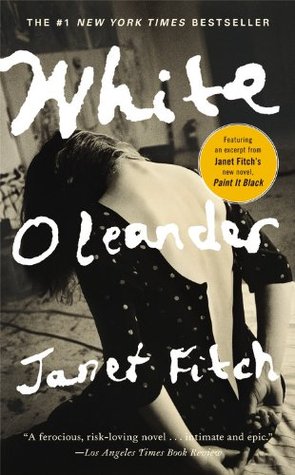
Title: White Oleander
Author: Janet Fitch
Publishers: Little, Brown and Company (2001)
Genre(s): Contemporary, Women's Fiction
Format: Paperback (496 pages)
Average Rating on Goodreads: 3.87/5
When Astrid's mother, a beautiful, headstrong poet, murders a former lover and is imprisoned for life, Astrid becomes one of the thousands of foster children in Los Angeles. As she navigates this new reality, Astrid finds strength in her unshakable certainty of her own worth and her unfettered sense of the absurd.

Title: Black Like Me
Author: John Howard Griffin
Publishers: NAL Trade (2003)
Genre(s): Memoir, Non-Fiction
Format: Paperback (200 pages)
Average Rating on Goodreads: 4.08/5
In the Deep South of the 1950s, journalist John Howard Griffin decided to cross the color line. Using medication that darkened his skin to deep brown, he exchanged his privileged life as a Southern white man for the disenfranchised world of an unemployed black man. His audacious, still chillingly relevant eyewitness history is a work about race and humanity-that in this new millennium still has something important to say to every American.

Title: Green Eggs and Ham
Author: Dr. Seuss
Publishers: Random House (1960)
Genre(s): YA, Humor
Format: Hardcover (62 pages)
Average Rating on Goodreads: 4.30/5
Illustrated in color. Sam-I-Am mounts a determined campaign to convince another Seuss character to eat a plate of green eggs and ham. Green Eggs and Ham is a best-selling and critically acclaimed children's book by Dr. Seuss (a pen-name of Theodor Seuss Geisel), first published on August 12, 1960. As of 2001, according to Publishers Weekly, it was the fourth best-selling English-language children's book of all time.[1] The story has appeared in several animated videos starting with 1973's Dr. Seuss on the Loose: The Sneetches, The Zax; Green Eggs and Ham starring Paul Winchell as the voice of both Sam-I-am and the first-person narrating man.
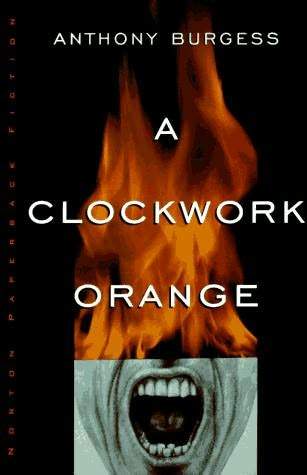
Title: A Clockwork Orange
Author: Anthony Burgess
Publishers: W. W. Norton and Company (1995)
Genre(s): Sci-fi, Dystopia, Mystery
Format: Paperback (213 pages)
Average Rating on Goodreads: 3.94/5
A vicious fifteen-year-old "droog" is the central character of this 1963 classic, whose stark terror was captured in Stanley Kubrick's magnificent film of the same title.
In Anthony Burgess's nightmare vision of the future, where criminals take over after dark, the story is told by the central character, Alex, who talks in a brutal invented slang that brilliantly renders his and his friends' social pathology. A Clockwork Orange is a frightening fable about good and evil, and the meaning of human freedom. When the state undertakes to reform Alex—to "redeem" him—the novel asks, "At what cost?"
This edition includes the controversial last chapter not published in the first edition and Burgess's introduction "A Clockwork Orange Resucked".

Title: The Silver Chair (The Chronicles of Narnia #4)
Author: C. S. Lewis
Publishers: HarperCollins Publisher (2005)
Genre(s): Young Adult, Fantasy
Format: Paperback (268 pages)
Average Rating on Goodreads: 3.91/5
The story starts when Eustace Scrubb, introduced in The Voyage of the Dawn Treader, is driven into the company of classmate Jill Pole at their miserable school Experiment House. The impetus is their need to find sanctuary from the gang of school bullies who run rampant in this laissez-faire and mismanaged school run by an incompetent headmistress. Eustace confides to Jill that he has recently been "out of this world" to a land called Narnia, and that his experiences there have led to the changes in his behaviour that everyone seems to have noticed. Jill initially believes that Eustace is lying, but when he promises and asks her to attempt to go to Narnia with him, she agrees. When the bullies are about to converge on the two, Eustace suggests asking for Aslan's help, and the two blunder through a gate that leads them to a high cliff in Aslan's Country.

Title: Blue Highways (The Travel Trilogy #1)
Author: William Least Heat-Moon
Publishers: Back Bay Books
Genre(s): Memoir
Format: Paperback (428 pages)
Average Rating on Goodreads: 3.98/5
Hailed as a masterpiece of American travel writing, Blue Highways is an unforgettable journey along our nation's backroads. William Least Heat-Moon set out with little more than the need to put home behind him and a sense of curiosity about "those little towns that get on the map-if they get on at all-only because some cartographer has a blank space to fill: Remote, Oregon; Simplicity, Virginia; New Freedom, Pennsylvania; New Hope, Tennessee; Why, Arizona; Whynot, Mississippi." His adventures, his discoveries, and his recollections of the extraordinary people he encountered along the way amount to a revelation of the true American experience.
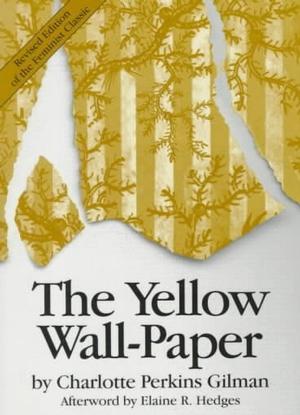
Title: The Yellow Wall-Paper
Author: Charlotte Perkins Gilman
Publishers: The Feminist Press (1996)
Genre(s): Short Stories, Feminism
Format: Paperback (64 pages)
Average Rating on Goodreads: 4.11/5
First published in 1892, The Yellow Wall-Paper is written as the secret journal of a woman who, failing to relish the joys of marriage and motherhood, is sentenced to a country rest cure. Though she longs to write, her husband and doctor forbid it, prescribing instead complete passivity. In the involuntary confinement of her bedroom, the hero creates a reality of her own beyond the hypnotic pattern of the faded yellow wallpaper – a pattern that has come to symbolize her own imprisonment. Narrated with superb psychological and dramatic precision, The Yellow Wall-Paper stands out not only for the imaginative authenticity with which it depicts one woman’s descent into insanity, but also for the power of its testimony to the importance of freedom and self-empowerment for women.
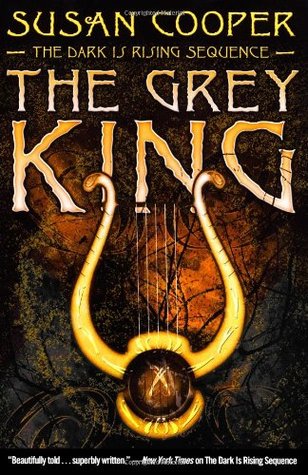
Title: The Grey King (The Dark Rising #4)
Author: Susan Cooper
Publishers: Simon Pulse (2007)
Genre(s): YA Fantasy, Mythology
Format: Paperback (165 pages)
Average Rating on Goodreads: 4.18/5
"Fire on the Mountain Shall Find the Harp of Gold Played to Wake the Sleepers, Oldest of the Old...""
With the final battle between the Light and the Dark soon approaching, Will sets out on a quest to call for aid. Hidden within the Welsh hills is a magical harp that he must use to wake the Sleepers - six noble riders who have slept for centuries.
But an illness has robbed Will of nearly all his knowledge of the Old Ones, and he is left only with a broken riddle to guide him in his task. As Will travels blindly through the hills, his journey will bring him face-to-face with the most powerful Lord of the Dark - the Grey King. The King holds the harp and Sleepers within his lands, and there has yet to be a force strong enough to tear them from his grasp...

Title: My Name is Red
Author: Orhan Pamuk
Publishers: Vintage (2002)
Genre(s): Contemporary, Literary Fiction
Format: Paperback (417 pages)
Average Rating on Goodreads: 3.79/5
At once a fiendishly devious mystery, a beguiling love story, and a brilliant symposium on the power of art, My Name Is Red is a transporting tale set amid the splendor and religious intrigue of sixteenth-century Istanbul, from one of the most prominent contemporary Turkish writers.
The Sultan has commissioned a cadre of the most acclaimed artists in the land to create a great book celebrating the glories of his realm. Their task: to illuminate the work in the European style. But because figurative art can be deemed an affront to Islam, this commission is a dangerous proposition indeed. The ruling elite therefore mustn’t know the full scope or nature of the project, and panic erupts when one of the chosen miniaturists disappears. The only clue to the mystery–or crime? –lies in the half-finished illuminations themselves. Part fantasy and part philosophical puzzle, My Name is Red is a kaleidoscopic journey to the intersection of art, religion, love, sex and power.
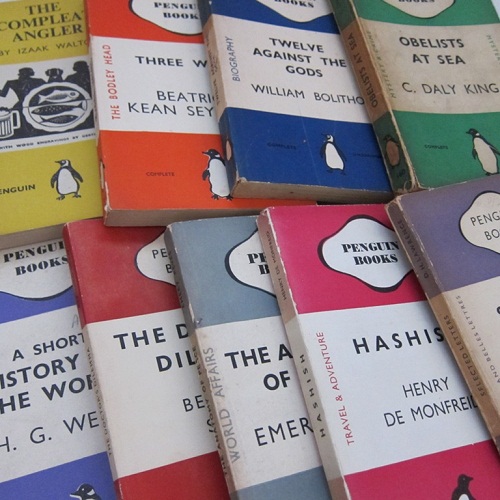
The Penguin Books Color Codes
Arranging books according to color has become quite popular and looks great. However, it is a method that can result in placing paleontology next to poetry and novels next to non-fiction, a troubling thought indeed! That's why I adore the color-coding system that Penguin has been using 1935, wherein each genre is assigned a color and the spine (and sometimes the cover) of works within that genre are printed in the designated color.
The Penguin code is as follows:
Red = Drama
Orange = Fiction
Yellow = Miscellaneous
Green = Crime Fiction
Dark Blue = Autobiographies
Purple = Essays
Cerise = Travel and Adventure
Grey = World Affairs
Red = Drama
Orange = Fiction
Yellow = Miscellaneous
Green = Crime Fiction
Dark Blue = Autobiographies
Purple = Essays
Cerise = Travel and Adventure
Grey = World Affairs
For more info check out: Phil Baines' book, Penguin by Design: A Cover Story 1935-2005
Finally, once again Happy Holi to all of you!!! (even if you're not playing with colors).
Have Fun & Keep Reading!


